Introduction
It seems hard to believe that Berg’s Wozzeck was premiered 100 years ago on the 14th of December 1925. It sounds and feels as contemporaneously lifelike and terrifying in today’s world, both musically and psychologically, as though it were a confrontationally new landmark in our own time right here and now. Can one try and imagine its impact at the Berlin State Opera at its premiere?! Well, one of the exclusive interviews in this Hampsong Foundation Wozzeck Centenary Celebration tells us about that from first-hand experience. In 1995, the 92 year old composer and conductor Berthold Goldschmidt recalled to Jon Tolansky, the compiler and producer of this project, the opening night, in which he was playing the celeste when the conductor Erich Kleiber was at the helm. There had been 34 orchestra rehearsals – and a total of 137 rehearsals with all the artists! The demands for everyone had been unprecedented. And, remarkably after 100 years, they remain uniquely challenging – musically, dramatically, and psychologically. All these elements are discussed by the internationally acclaimed artists featured in this centenary celebration of a truly unique landmark in operatic history.
Included in the interviews with Thomas Hampson and Sir Antonio Pappano are important references to another extraordinary and unprecedented landmark that was the inspiration for Berg’s opera – the original unfinished sketches for a play, Woyzeck, that the 23 year old Georg Büchner penned, almost unbelievably in 1836, inspired by his investigation into the history behind a true event: the public execution of a barber, later a soldier, called Woyzeck for murdering his unfaithful mistress in a fit of jealousy, and which for Büchner was a profound miscarriage of justice when he discovered what Woyzeck had been suffering.
Jon Tolansky, September 2025
Baritone Franz Grundheber
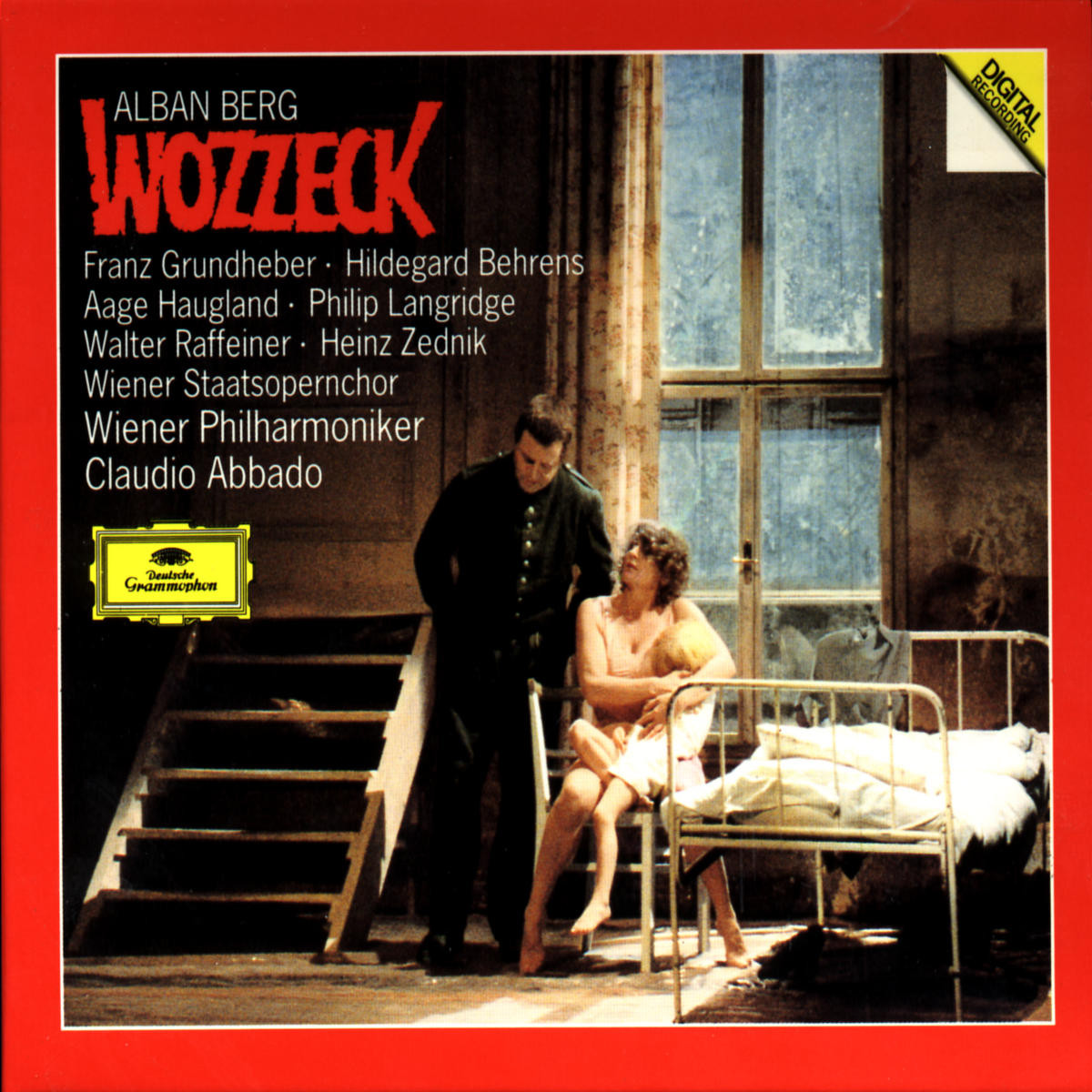
A) Baritone Franz Grundheber – three short extracts from an interview Jon Tolansky made with him by telephone in 2020. These are included by kind permission of the Editor of Opera Magazine, John Allison, who had commissioned an interview with Mr Grundheber. Two very brief music extracts are included from the recording in which he sang the role of Wozzeck with Claudio Abbado conducting.
Alban Berg: Wozzeck
Grundheber · Behrens · Raffeiner
Langridge · Zednik · Haugland
Šramek · Maly
Wiener Sängerknaben
Wiener Staatsopernchor
Wiener Philharmoniker
Claudio Abbado
November 21, 1988
Decca Classics / Deutsche Grammophon: 00028942358720
Baritone Thomas Hampson
B) Baritone Thomas Hampson – two separate interviews: one interview of 20 minutes’ duration recorded with Jon Tolansky in 2023, and one interview of 6 minutes’ duration recorded with Jon Tolansky this year, 2025.
Baritone Sir Simon Keenlyside
C) Baritone Sir Simon Keenlyside – an interview of 31 minutes’ interview, made with Jon Tolansky on the 8th of September of this year, 2025, and recorded from a Facetime audio feed.
Conductor Sir Antonio Pappano
D) Conductor Sir Antonio Pappano – an interview of 27 minutes’ duration, made with Jon Tolansky on the 19th of September of this year, 2025, in video vision.
Soprano Anja Kampe
E) Soprano Anja Kampe, responding in text, in August 2025, to written questions sent to her by Jon Tolansky.
Does Ms Kampe agree with me that the opera is in a sense a double tragedy – a tragedy as much for Marie as for Wozzeck?
That is not really a question, but a statement. There is actually no other interpretation than that this drama is the tragedy of both protagonists. It essentially follows the form of the classical tragedy, where the fate of the characters is unavoidable from the very beginning.
The horrible and sick social environment – this is as much terrible for Marie as it is for Wozzeck?
That has already been answered with the previous question. Wozzeck and Marie come from the same social milieu. From the outset, both of them have no chance.
Is it at all possible for Marie to try and understand what torments Wozzeck?
To a certain extent she does understand him, because, as I have now said twice, their fate is the same. She probably does not understand every one of his actions. For example, it remains a mystery to her why he is always so withdrawn. But of course, there is a fundamental understanding between Marie and Wozzeck.
Does Ms Kampe think Wozzeck is insane? Or is he just violently disturbed, which is not the same as being fully insane?
How do you come to the conclusion that Wozzeck is insane? There is not a single line in the play that suggests that. Wozzeck, in the time Büchner portrays him, had no choice. Today, however, he would be an ordinary voter: susceptible to conspiracy theories and fake news – but still without any chance. Just read the dialogue with the Captain in the very first scene of the piece! This man is neither insane nor stupid. In fact, he gives the Captain a razor-sharp analysis of his social situation.
If Wozzeck was giving Marie a true relationship, would Marie still have found the Drum Major impossible to resist?
Wozzeck is in a true relationship with Marie. There can be no doubt about that. And he shows great responsibility towards this relationship and the child – otherwise he would not work himself to death and allow himself to be exploited by the Doctor. However, the situation overwhelms him in every respect. Apart from his obligatory presence in the barracks, he has to work constantly in his free time to support his little family. But for Wozzeck this is his family and the center of his life. And as for the relationship between Marie and the Drum Major – such questions cannot really be answered in a serious way. The Drum Major represents another world and gives Marie, for a few brief moments, a certain illusion. If Wozzeck lived at home and were better off socially – who knows? Possibly not – or perhaps yes.
Would Ms Kampe like to say how the role of Marie demands lyrical singing as well as sprechstimme?
The answer is written very clearly in the score itself. If you carefully read Berg’s instructions, especially in the so-called Bible Scene – which is the greatest challenge for the singer of Marie – then you will also find the answer: lyrical voice, dramatic voice, Sprechstimme, speaking in song, singing speech – in short, all possible expressive colors that should be available to a singer, provided one takes the role truly seriously.
Composer and conductor Berthold Goldschmidt
F) Composer and conductor Berthold Goldschmidt – a brief interview made with Jon Tolansky in 1995, when he recalled playing the celeste in the world premiere of Wozzeck in 1925.